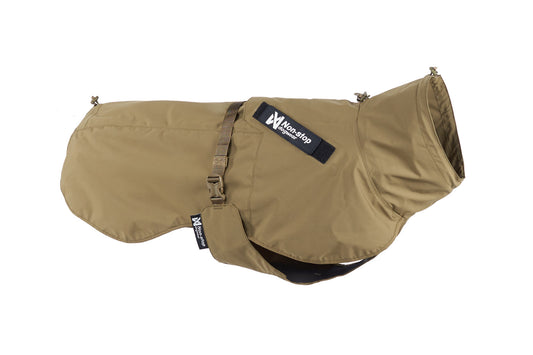
The fit factor: inside the design of our dog jackets
“What size should I choose?” – This might be the most common question dog owners face when purchasing a dog coat. And for good reasons. Dogs come in an infinite number of shapes and sizes, which can cause headaches when finding apparel that fits and also performs.
At Non-stop dogwear, designing performance dog apparel always starts from the dog’s perspective. From the Langdistansedekken – the first version of what’s now called the Long distance jacket - in 2012, to the 15+ styles we offer today, fit has never been an afterthought, but one of the most important elements of the product.
We sat down with Matthew Brown, Head of Design and Development, to share how we approach sizing jackets, why it’s complex, and how we build gear that truly supports movement, protection, and comfort at the same time.
Fit is the first protection
So why does wearing the right size matter so much?
“To ensure a secure fit that offers freedom of movement and sufficient protection. “ – Matthew Brown
A jacket that doesn’t fit can cause problems you don’t want to face out on the trail, or simply fail to perform as intended.
“A jacket that is too small will not cover the dog fully thus creating cold spots. A jacket too big might slip off and become tangled with the dog.”
And over time, poor fit can lead to friction, discomfort or even open injuries, especially during longer outings or in harsh conditions.
Shaped by movement. Refined on the trails.
Even from the same breed, no two dogs are built exactly alike, which makes sizing far more nuanced than a simple guess.
“There are many different shapes and sizes of dogs. Long legs, short legs, big chest and short back length. Wide neck and small body. To have one jacket sizing that fits all these types is incredibly difficult and complex.”

That’s why we test extensively and rely on a large community of dogs who trial the garments on trails, in forests, on race tracks, and in extreme cold winds. It’s how our sizing evolves with real use.
“We have a wide test database of over a thousand dogs with different back and chest measurements. We ensure that at the very minimum, one dog from the smallest, medium, and largest sizes are tested - as well as dogs with both a long back and skinny chest, and also dogs with a wide chest and short back.”
Today, most Non-stop dogwear jackets come in 11 to 15 sizes. More sizes mean fewer compromises, less ‘almost fits’, less sliding, and more comfort for maximum peace of mind.
“So we can offer the best performance for the dog - both in terms of comfort, protection and freedom of movement.”
The function defines the fit
Every jacket in our assortment is built with a specific use in mind: whether it’s recovery, wet weather protection, full-body coverage, or warmth in arctic cold conditions. That intended function directly informs the cut, coverage, seam placement, and ultimately, how the jacket fits on dogs.
“Some jackets need more coverage on the legs for warmth and recovery, whereas others are designed specifically for running.
The Glacier series, for example, is designed to be an all-round fit with good movement and coverage. The Wool dog jacket is designed more for recovery and extra coverage - therefore it is not as good for running due to the longer length”, Matthew explains.

The Protector suit is another example. To provide maximum and full-body protection from snow, it requires a closer fit, with more critical seam placement than other styles.
“With a tighter suit, seam placement is very important. Therefore more sizes are needed to ensure there is a lower risk of chafing.”
A fit that works in one jacket may not in another - and our sizing system reflects that.
Which jacket is best for your dog? Take our Quiz
Sizing system: Why back length works
There are several ways to size a dog jacket. At Non-stop dogwear, we build our system around back length. Matthew explains:
“The back length ensures correct coverage of the dog’s body. We then have an adjustable chest to fit a wide range of shapes. If the jacket was based on chest measurements, you could end up with a jacket too long - or even worse, too short.”

Non-stop dogwear jackets feature up to six adjustment points at the neck, shoulders, chest, and tail, each serving to fine-tune coverage and mobility. Shoulder and tail cinch points help reduce the jacket’s length, while the neck adjustment also seals out water, snow, and debris. Product pages include detailed dimensions such as head opening and chest circumference to support accurate sizing, especially for dogs with unique builds.
How do you know it fits?
Matthew’s rule of thumb for checking fit is simple:
“If the jacket is over the dog’s tail by 5+ cm, the jacket is too big. If the jacket is too small, then the back will be shown by 5+ cm. Both of these could hinder the movement of the dog.”
The jacket should move with the dog. Not flap. Not ride up. Not sag.
If ever in doubt, our support team is always glad to provide personal fitting advice.
Non-stop process
Sizing is never “done.” As more activities shape how gear is used, development continues.
Matthew shares what’s ahead.
“For now, the sizing has been and always will be a constant development and is improving year on year with new jackets and projects - mostly thanks to great customer feedback and testing.
“It can be that there are jackets in the pipeline that are more specific to breed types. Watch this space!”