When disaster strikes, they are ready: Inside the world of international search and rescue dogs
On June 24th, two major earthquakes struck north-central Venezuela within two minutes of each other. In moments, thousands of people were buried under collapsed buildings.
Watching the news unfold, Václav Vančura, a 37-year-old firefighter and search-and-rescue dog handler with the Fire Rescue Service of the Czech Republic, knew immediately what it could mean for him and Origami, his four-year-old Belgian Shepherd: they could soon be called to deploy to help search for survivors.
In Slovakia, Michal Palovič, a 32-year-old professional mountain rescuer and search and rescue dog handler with the Slovak Mountain Rescue Service, was facing the same possibility with his German Shepherd, Zerro. Both dog-handler teams were shortlisted as part of their countries’ Urban Search and Rescue (USAR) response for major international deployments. They went on standby, ready to leave home at a moment’s notice.
Coordinated by the International Search and Rescue Advisory Group (INSARAG), a UN body focused on preparedness and response to devastating structural events like earthquakes, 71 USAR teams from 31 countries were deployed to help rescue and recover victims of the twin earthquakes. Among them, certified search-and-rescue dogs and their handlers arrived with one crucial, time-sensitive mission: locating victims buried under massive rubble. A task no human or piece of technology can do as fast or as precisely. According to Jorge Rodríguez, President of Venezuela's National Assembly, 137 trained dogs took part in the search.
Ready to leave in a matter of hours
With thousands of lives on the line, and a fourteen-hour flight ahead, there was no time to wait.
Václav and Origami, and Michal and Zerro went into a state of readiness, awaiting confirmation that their country’s USAR team would be activated. “Within about an hour and a half I can be fully prepared for a mission that may last up to two weeks“, explains Václav, this was his third international deployment.
Packing, last-minute vaccinations, veterinary check, and administrative procedures – completed as fast as possible - are the final layer of a preparation built over years of training.
“Readiness for an international deployment is the result of many years of regular training and preparation”, says Michal. He and Zerro hold the IRO Mission Readiness Test (MRT) certificate, the international benchmark for operational deployment.
To be available for international deployment no matter when, both dogs and handlers must be prepared physically, mentally, and medically at all times. Zerro has to navigate unstable, unfamiliar terrain that demands excellent physical condition and endurance, and stay focused despite noise and distracting scents. He's regularly checked by a Slovak Mountain Rescue Service veterinarian, so he can be cleared to deploy at short notice. Michal faces the same standards to also be an asset to his team.
“Both the handler and dog must depart in the best possible condition,” shares Michal.
On the field: international and cross-team cooperation
After landing in Venezuela, eight Czech and four Slovak dog-handler teams were escorted to their assigned search zones. From there, the search began, each team coordinated to work towards the same goal, regardless of country: finding and rescuing as many survivors as possible.
“I believe international cooperation has improved enormously over the years,“ says Václav. “We return home with valuable experience that shapes future training for both handlers and dogs.“

The two men’s USAR teams have already trained together with Poland’s, and further training with Lithuania’s team is next. It means that when a real mission calls, handlers already know how to work in unison.
Once a dog signals a possible survivor, acoustic listening units and search cameras move in to confirm the exact spot. “It was impressive to see everyone become silent, vehicle engines being switched off, and people waiting patiently so that the technical rescuers could detect even the faintest sound from beneath the rubble,“ says Michal.
The irreplaceable role of search and rescue dogs
“Nothing can replace a well-trained search dog,“ says Václav. “Modern technology complements them, it does not replace them“.
Dogs are the first to search a zone. Only once they signal they’ve located a possible survivor, do the technical teams proceed further.
Trained to detect one specific scent, human scent, in Zerro and Origami's case, a dog's nose becomes an extraordinary detection instrument. Their agility and low profile let them enter and search confined spaces no human rescuer could reach. “The greatest advantage of a trained search dog is the speed at which they can detect human scent and search a large or complex rubble site,” says Michal.

Zerro at a search site in Venezuela.
Not every rescue team has trained dogs in its ranks, and having 137 trained dogs on-site was an incredible asset for every rescue team involved. Coming with eight dogs, the Czech search-and-rescue team could work independently, but international cooperation went beyond each team’s own ranks. “There were occasions when we worked alongside rescue teams from Venezuela and Chile that did not have search dogs,” says Václav.
More than their skills, dogs’ presence itself is helpful to the local population. “After such a devastating disaster, contact with the dogs provided a form of emotional support and comfort to those affected,” Michal shares.
No room for doubt
“I had to trust Zerro throughout the entire mission. If he did not indicate anything, I had to trust his work and judgement that there was no survivor in that part of the rubble”, shares Michal. Years of training together built the level of mutual trust it takes for Michal to tell the team, with certainty, that no one is left behind in a searched area.

Left: Michal and Zerro at a search site. Right: Václav and Origami hydration break and rest between search rounds.
“Zerro must trust that I won't send him into an unnecessarily dangerous situation, and that I'll support and protect him in a challenging or unstable environment,“ Michal continues.
“Success depends equally on teamwork and the dog’s independence,” explains Václav.
Sometimes that independence means letting your dog disappear out of sight where you can’t follow them,
During one search, Václav sent Origami into a narrow tunnel beneath a collapsed building.
She disappeared.
One minute passed. Then another.
For almost ten minutes, Václav had not visual contact with Origami, and had no idea where she was.
Eventually, Origami emerged.
Only afterwards, when Václav downloaded footage from the camera mounted on her harness, did he realise just how incredibly difficult the terrain had been.
“Watching how confidently and professionally she navigated those spaces made me incredibly proud.”
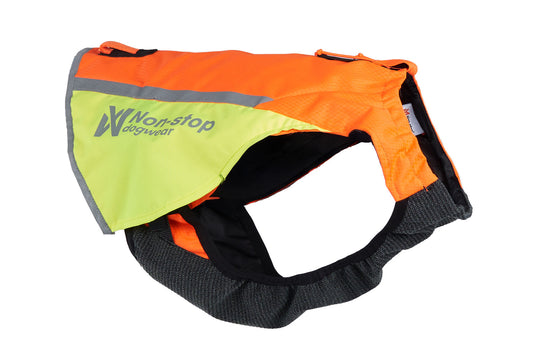
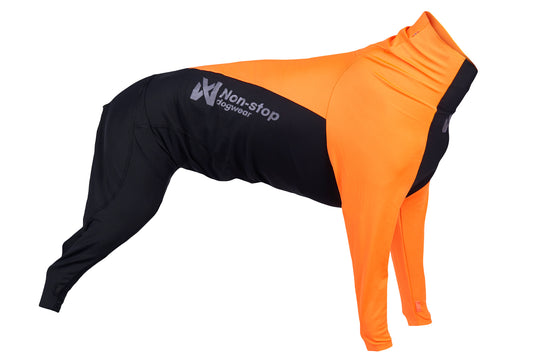
In environments like these, everything a dog carries or wears has to allow them to do their job. They need to climb, crawl, squeeze through gaps and make decisions independently, without unnecessary restriction.
Protecting the one who protects others
“Zerro’s safety and health must always come first,” shares Michal. His canine partner can only work as effectively if he’s healthy and well-rested.
As international rescuers Michal and Václav have to be ready to adapt to whatever climate they land in, so their dogs can still do their job.
On this mission, the extreme heat and high humidity were a real challenge. “Even while resting, the dogs were working hard simply to cool themselves by panting,” recalls Václav.

Origami rests and cools down with a member of the Czech USAR team between search rounds, a welcome moment of calm for them both.
Protecting their dogs from the heat meant cutting the usual 30-minute search round down to a maximum of 10 minutes - sometimes as little as five or six on exposed, sun-baked rubble. Between searches, the dogs were given time to rest, hydrate and cool down. Cooling vests also became part of managing their body temperature and helping them recover between working rounds. Years of training let handlers recognise when to stop a search, and when their partner is ready to go again.
With extremely hot temperatures and rubble full of sharp debris and glass, protective booties on Origami and Zerro were non-negotiable. “Even a minor paw injury can prevent a rescue dog from continuing to work,“ says Michal.
Canine Heroes of Venezuela
Venezuela awarded Origami and Zerro - together with 34 other USAR dogs from 12 countries - the decoration of “Canine Heroes of Venezuela.“ Acting president Delcy Rodríguez presented it after more than a week of searching, in recognition of the dogs who located survivors and recovered the dead, work that gave grieving families certainty.
“I sincerely hope disasters like these become less frequent,“ says Václav. “But if people need our help anywhere in the world, we will be ready.“