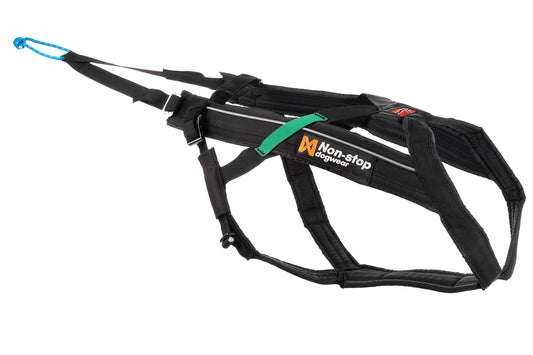
How to choose the right pulling harness for dog-powered sports
In dog-powered sports, where your dog walks or runs in front of you connected by a line, and uses their strength to help move you or equipment forward, the most important piece of gear is a good harness made to work under tension.
A purpose-built pulling harness, unlike an everyday harness, distributes that force and transfers the power efficiently while allowing your dog to move naturally and comfortably.
The best harness depends on your activity, the direction of pull, and your dog's individual build.
If you’re not sure which harness to choose for your dog, this guide will help you understand which harness your dog needs, how it should fit, and answer the most frequently asked questions about dog pulling harnesses.
In a rush? Take our interactive dog harness quiz to quickly find out the harness that fits your needs.
What harness should I choose for my dog?
Choosing the right harness starts with what you and your dog plan to do together, as this determines whether your dog needs a high- or low- pulling point harness. Next, compare the models designed for your activity and choose the one that best matches your dog’s needs and physiology (see our pulling harness guide below). Finally, try on the harness and make sure it fits correctly under tension.

Tested and trusted by world-leading athletes in dog-powered sports, our harnesses are shaped around canine anatomy with a focus on ergonomic fit, function, and performance at every level. Whether your dog is exploring trails, training, competing, or working, the goal remains the same: to support their natural abilities without restricting movement.
High or low pulling point: what is the difference?
One of the most important factors when choosing a harness for dog-powered sports is the direction of pull.
High-pulling point for canicross, bikejoring, skijoring and hiking
When the line runs upward from your dog to a waist belt, bike antenna, or similar attachment, the pulling point is higher than their back.
A harness for this situation should follow that angle so the load remains balanced as your dog drives forward. Freemotion-style harnesses are developed for this type of pull.
Low-pulling point for mushing and resistance work
When the line runs straight back toward a sled, rig, cart, or low resistance such as chains or a tire, the pulling point is lower.
X-back harnesses, also sometimes called nome harnesses, are shaped to carry tension in this direction.
Dog harnesses for canicross, bikejoring, and skijoring
Freemotion harness 5.0: Our signature pulling harness

The Freemotion harness 5.0 is a great choice for most dogs in canicross, bikejoring and skijoring, especially those that pull steadily or powerfully.
Born from the need for a sporting dog harness that doesn’t restrict motion or breathing, its Y-shaped front, open shoulder area and adjustable pulling angle are designed exactly for that. Multiple adjustment points make it suitable for a wide range of dogs and body shapes.
Best for: Canicross, bikejoring, skijoring and other activities with a high pulling point.
DISCOVER FREEMOTION HARNESS 5.0 DISCOVER FREEMOTION HARNESS
Rush harness: Pulling made easy

The Rush harness is a shorter, lighter option that is quick to put on and easy to adjust. It is particularly suitable for dogs that need a simpler design or do not fit traditional long pulling harnesses, including dogs with a shorter back or broader neck and head.
Despite its shorter design, the Rush harness is built to handle powerful pulling, while remaining a versatile choice for everything from dog-powered hiking and running to bikejoring.
Best for: Versatile use, dogs new to dog-powered sports, and dogs that benefit from a shorter pulling harness.
Freemotion harness pro: for racing dogs and a close fit

The Freemotion harness pro is our lightest, closest-fitting, and most advanced pulling harness designed for racing in canicross, bikejoring and skijoring.
Its CleanSeam™ construction creates a smooth, body-hugging fit that stays close to the body under full tension without restricting movement or breathing at speed. Anti-slip adjustment straps help keep the harness stable under tension, while small neck options provide a better fit for dogs with a slim neck.
Best for: Racing, high-speed performance in canicross, skijoring and bikejoring.
DISCOVER FREEMOTION HARNESS PRO
Combined harness: for pulling a pulka

The Combined harness is designed for activities where your dog pulls a small sled, called a pulka, behind them. In combined skiing, the pulka travels between your dog and you while you ski behind.
This creates a different pulling angle and load than regular skijoring. The Combined harness is based on the Freemotion shape, with a reinforced neck and dedicated attachment points for the pulka. An optional girth strap helps keep the harness in place if your dog stops or backs up.
Best for: Pulka and combined skiing.
Freemotion harness WD: for working dogs and resistance training

The Freemotion harness WD is the right pulling harness for working dogs building strength and endurance, or for handlers who need a robust, multifunctional harness.
In addition to the high pulling point of the Freemotion design, it features side rings compatible with the Pulling attachment WD, enabling controlled resistance work with equipment such as a tire or chains.
Best for: Working dogs, strength and endurance training, and controlled resistance work.
DISCOVER FREEMOTION HARNESS WD
Dog mushing harnesses for a low pulling point
Nansen nome harness 5.0: the classic X-back harness

The Nansen nome harness 5.0 uses a traditional X-back construction to transfer pulling force toward a low attachment point, making it ideal for dogs pulling a sled, rig or cart.
Used and trusted by medal-winning teams in sprint, middle-distance and long-distance racing since 2010, it combines a stable and ergonomic fit, thick padding and durable construction for demanding mushing conditions. The traveling attachment follows the changes in direction to level the harness and decreases the risk of strain, especially for dogs pulling to one side.
Best for: Mushing, sled dogs and other activities with a low pulling point.
DISCOVER NANSEN NOME HARNESS 5.0
Nansen stick harness: for rear positions and training

The Nansen stick harness is designed for wheel and rear dogs, which experience a different pulling load than dogs farther forward in a dog team.
Co-developed with six-time Iditarod champion Dallas Seavey, its elastic rear section and stick help distribute the load with less pressure around the rear of the dog. It can also be used for light resistance training with tires or chains.
Best for: Wheel and rear dogs in mushing teams and selected resistance training.
How should a dog pulling harness fit?
A well-fitted harness keeps the shoulders free, the airway open, and the spine aligned with the direction of pull. When the harness shape and the fit are right your dog can settle into a natural, powerful, and efficient stride.
Pulling harnesses are designed to fit differently from everyday harnesses, so some areas may look loose when your dog is standing still.
Always check the fit under tension. The harness is designed to sit correctly when your dog leans forward and pulls.
Tip: Ask someone to hold the line, or secure it safely to a fixed point, and let your dog lean forward naturally while you check the fit.
- Neck: You should be able to place two vertical fingers between the harness and the neck, a bit more for larger dogs and a bit less for smaller dogs. The neck opening is purposefully designed for a snug fit that doesn’t fall over the shoulders.
- Sternum: Find the upper end of your dog’s sternum (breastbone). In pulling position, the bottom of the harness’s neck opening should rest at or below this point, not above it. Some models allow the front angle to be adjusted via side straps.
- Armpits: There should be clear space behind the front legs when your dog pulls. Aim for at least two fingers of clearance so the straps do not rub with every stride.
- Rib cage: The harness should not cover the last rib or extend onto the soft abdomen.
- Back and attachment point: On a long pulling harness, the rear attachment should reach the base of the tail when your dog is pulling at the intended pulling angle.
Signs the harness may not fit
Shortened strides, coughing, noisy or unusually heavy breathing, rubbing, repeated twisting, a harness that slides over the shoulders, reluctance to pull, or resistance when the harness appears are all reasons to stop and reassess. With adjustable harnesses, a common mistake is leaving the side straps too loose, which can cause the harness to sit too high on the neck or shift sideways.
What should I look for in a dog-powered sports harness?
Freedom of movement
The harness should allow your dog to run and breathe naturally, with free shoulder movement, room for the rib cage to expand, a neutral spine, free movement through the hips, and a full rear stride. A Y-shaped front leaves space around the shoulder joints and keeps the harness away from the throat when properly fitted.
Correct fit
Even the right harness design cannot work correctly in the wrong size or if it is not properly fitted.
Under tension, the harness should stay centered, sit clear of the armpits, and remain close enough around the neck that it does not slide onto the shoulders.
Materials you can trust under load
Equipment for dog-powered sports is exposed to repeated tension, sudden changes in speed, mud, rain, snow, and frequent washing.
Strong webbing, secure attachment points, durable seams, and padding that keeps its shape help the harness withstand demanding use and perform reliably over time. Durable materials also help extend the life of the harness, reducing wear and the need for premature replacement.
Frequently asked questions about dog pulling harnesses
Will a pulling harness make my dog pull on everyday walks?
Not by itself. Dogs can learn that different equipment and cues mean different rules. It is important to use the pulling harness only for the activity, introduce a clear start cue, and remain consistent about loose-leash behavior in their everyday collar or walking harness. Many dogs quickly recognize the pulling harness as their signal that something fun is coming up!
Can my dog wear a pulling harness?
Most healthy, physically mature dogs can enjoy pulling sports when the activity, training load, and harness are appropriate. Pulling is not limited to traditional sled-dog breeds, the key is a safe fit and a gradual introduction. Puppies should wait until their bones and joints are sufficiently developed before consistent pulling, commonly around 12–18 months depending on breed and individual development. Senior dogs, dogs returning from injury, and dogs with orthopedic, cardiovascular, or respiratory conditions should be assessed by a veterinarian first.
Why do the top straps bunch up when my dog is not pulling?
This can be normal on Freemotion and Rush models. Without tension, the top straps may lift or gap because the harness is shaped for the working position. They should settle flatter when your dog leans into the harness.
Why do most Non-stop dogwear pulling harnesses use a rope attachment, and is the knot safe?
The rope end-loop provides a strong, practical attachment point designed for the repeated loads of pulling sports. It withstands over 600 kilograms of force and is secured with a Fisherman’s knot, a trusted load-bearing knot that tightens as tension is applied.
On our mushing harnesses, the loop color also helps you identify the neck size at a glance: blue indicates a full size, red indicates a half size. This makes it easier to select the correct harness when managing equipment for several dogs.
As with all load-bearing equipment, check the rope and knot before the first use and regularly throughout the harness’s lifetime.
The neck opening is difficult to pull over my dog’s head. Is the harness too small?
Not necessarily. Pulling harnesses are intentionally close around the neck so they do not fall onto the shoulders. It should still pass without force and fit correctly once your dog is in pulling position. Turn the neck opening about 90 degrees before guiding it over the head, then rotate the harness back into position. Reverse the steps when removing it, flipping the outer side inward to help it out and gently holding your dog’s neck.