Take the leap: how to start dock diving
A dog toy cuts through the air. Muscles loaded, a dog pushes hard from the dock, leaps and defies gravity for several meters, then catches the target before splashing into the water below. The crowd cheers loudly.
From the outside, this can look like a lucky jump on a playful sunny day. In reality, this dog and their human are a dock diving duo. They have been developing a keen and deep relationship based on trust, motivation, and physical training to transform their toss and catch game into a true sport.
Spectacular to watch and even more rewarding to practice, dock diving is a canine water sport where dogs jump from a dock into water, chasing a bumper (a floating toy to retrieve). The goal can be distance, speed, height, but above all the joy of playing and growing as a team.
To encourage you to leap, here is what you need to know before starting dock diving, with expert input from Valeria Di Bartolomeo, international dock diving competitor and founder of DK Centro Cinofilo Acquatico, one of Italy’s leading canine water sports training centers.
What is dock diving?
Dock diving is a canine water sport where a dog jumps off a dock into a pool, lake, pond, or safe body of water. The dog is motivated to try and either jump the farthest distance, highest height, or fastest retrieve, depending on the discipline. Built on positive reinforcement through play, praise, toys, and trust, it is an all-around sport where your dog gets movement, water fun, and mental stimulation, while you build a stronger connection. It can be practiced all year but is a great alternative when it is too hot for high-intensity activities.
You will find three main disciplines in competitions:
- Distance jumping, also called Big air, is the dog version of the long jump. Your dog leaps off the dock toward the dummy you have thrown, trying to achieve the longest distance possible from the dock to where their tail enters the water.
- Vertical jumping, also called Extreme vertical, is the dog version of the high jump. Your dog jumps to grab the bumper suspended above water. The height increases as the competition goes on.
-
Speed retrieving, also called Speed jump, is a race against the clock. Your dog jumps, swims fast, and retrieves the bumper suspended low at the end of the pool.
You can compete in one, two or all of the disciplines, which defines your dog as an Iron dog.

Can any dog become a dock dog?
Most can yes! All dogs are welcome to participate in dock diving regardless of their size or breed. Swimming is gentle on a dog’s body, making water work suitable for many dogs, from young to senior. Jumping, however, should always be introduced gradually, especially for growing dogs whose bodies are still developing.
Some breeds like Whippets, Belgian Malinois, Border Collies, and working Labradors are naturally predisposed to perform better due to their toy drive, explosiveness or athletic structure, but any other dog can perform just as well as them.
Valeria is clear on this point: “Individuality remains one of the most important factors and should never be underestimated.”
This is also why experienced guidance matters. A good trainer will not only look at how far your dog can jump. They will assess your dog’s confidence, motivation, swimming skills, body awareness, and emotional state before deciding what the next step should be.
If your dog is unsure of the water, start there first. Before you think about jumping, help them feel safe entering the water and swimming. Our course on how to teach your dog to swim is a good place to begin.
How to become a “flying dog”
1. Learn how to play with purpose
“Before stepping onto the dock, I believe it is fundamental to train the concept of chasing and catching a target”, Valeria says. “Catch is one of the fundamental elements in building a dock diving jump”.
Many dogs love toys, and playing together is something everyone can do. However, the goal is not to let excitement take over and have your dog running only on adrenaline. Here, you want them to chase with focus, follow a moving target, and stay connected to you in a highly stimulating environment.

“Mental and emotional work are just as important as athletic work”, explains Valeria. By playing with purpose, you activate motivation and make yourself interesting enough for your dog.”
A great starting point is chasing a ball. Later, frisbee work can help teach your dog to follow a target in a straight line and catch it in the air. This work on land builds skills your dog will use later on the dock, without adding the pressure of water too early.
2. Introduce water and dock diving progressively
Every dog has a different learning curve. Some dogs understand the game quickly, while others need several sessions just to feel confident entering the water.
In a first session, Valeria assesses the dog’s water confidence, athletic condition, motivation, and natural attitude. From there, she can decide whether the dog is ready for dock work or should first build confidence through swimming and other water exercises.
Most dogs start with distance jumps, close to the edge, then gradually increase distance as they understand the game. Other disciplines can come later.

Safety comes first. Valeria recommends using a flotation aid for beginners, even when they already swim well. With extra support, dogs can relax their movement, build confidence, improve their swimming technique, and use less energy staying afloat.
At the end of each step, your dog should come out of the water with a wagging tail and be eager to go again.
3. Build teamwork and technique
Your dog may be the one flying through the air, but every jump is the result of teamwork. Dock diving is growing in popularity around the world not only because it is impressive to watch, but because progress is built through small shared victories. From your dog’s very first jump to their best performance, you evolve as a team with each session.
“At a high level, dock diving almost becomes a geometric work made of precision, technique and deep teamwork between dog and handler”, shares Valeria. “Many people watch this sport and think it is simply “throwing a toy into the water”, but there is actually a very thin - and very precise - line between play and technical work.”
Here are five aspects to build into your sessions to go further, higher, and faster, while keeping your dog confident and motivated:
- Discipline: Focus on the target, holding the stay, and waiting for the release instead of launching on impulse.
- Timing: Knowing when to release your dog and when to throw, so the toy appears at the right moment and height in your dog’s line of movement.
- Movement: Learning balance, efficient breathing, managing speed, and to move fluidly from the dock into the air.
- Technique: Work on the throw, the angle, the target placement, and the catch, so your dog gets a chance to give their best jump.
- Communication: Your voice, body language, praise, and play all matter. Your team is as good as how you understand and read each other.
4. Be patient, trust the process
“Many people see their dog’s first jump and think that will always be their limit, but that is not true”, shares Valeria from her experience of training hundreds of dock diving teams. “I have seen dogs take years to completely change the way they jump, and eventually it happened. Without that patience, some dogs may never discover that they can become true flying dogs.”
Remember that progress is unique to each dog. With patience, repetition, consistency, and trust in both your dog and your instructor, you can build the foundations of a successful jump step by step.

5. Have fun!
“For a dog there is no good or bad jump”, Valeria reminds us. “What they perceive is the desire to collaborate, play and share that experience with their owner.”
No matter if your dog has jumped one meter or eight, they feel the thrill, they hear the tone of your voice, they feel your energy and whether you are proud of them. Celebrate every jump, so your dog feels successful and eager for the next round. When the dock becomes a place of confidence, play, and shared victory, progress follows naturally.
What equipment is needed to start dock diving?
The most important pieces of equipment support play, safety, and confidence.
- Dog toys: your main working tools! Choose a floating toy that is easy to see in the water and that your dog is excited to retrieve. It is best to only use it when dock diving, so it stays a valuable reward for your dog. A flying disc is also great to have for practicing chase and catch on land.
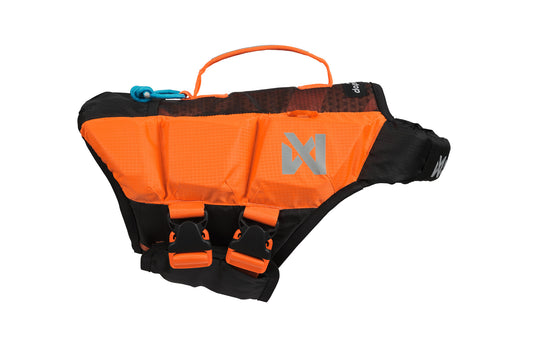
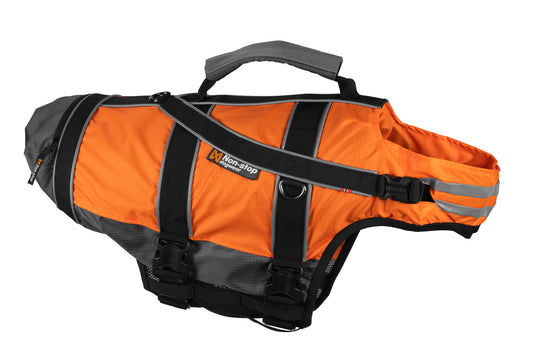
- A dog flotation device with a handle: a dog life jacket or dog swimming vest that allows free shoulder movement is strongly recommended for beginners. It supports confidence in the water and gives you better control during early training. Valeria also uses it as a training tool during exercises such as “place and stand,” where the dog learns the correct position and run-up before jumping. As your dog progresses and begins jumping longer distances, the life jacket should be gradually removed so they can absorb the landing naturally.
- A soft and solid collar: it helps you to handle your dog before and after the jump. Prefer a lightweight and breathable collar because it stays light, dries quickly, and remains comfortable during repeated sessions.
- A dog harness with a handle: as an alternative to the collar, it is a great training tool to transmit information, help with balance and intentions during training. Look for a harness that allows free shoulder movement for swimming, is breathable to prevent water retention, and dries quickly.
- A dog drying coat: your dog will rest more comfortably and dry and recover faster when using a good drying coat after repeated jumps. It also helps to reduce shivers in cool conditions, and saves you from wet dog smells in the car.
Ready to take the leap?
Dock diving is a relatively young dog sport that is growing quickly. It is an activity that can be practiced all year, especially when you want a fun way to beat the heat on summer days.
It starts with a dog who wants to play, a handler who listens, and a safe place to build confidence around water. If your dog loves toys, swimming, or learning new games with you, this might be the next sport to explore together.